


Content marketing is a strategic marketing approach focused on creating and distributing qualified and relevant content in order to both attract and retain a clearly defined target audience. Content marketing supports both new customer acquisition and retention of existing customers. If dealt with in a steady-handed and consistent manner, content marketing efforts ultimately enable sustainable profitability by providing high-added-value at a reasonable cost.
What Does Content Marketing Offer?
For years, push-style communication has been a dominant approach to marketing. Through advertising and direct marketing, brands have been pushed to audiences to promote their products or services. Now, we’re witnessing more and more brands moving beyond this type of purely outbound marketing and starting to mix up their marketing efforts. In this sense, inbound marketing pulls in customers at the customer-driven touchpoints. Content marketing is one of the most influential inbound marketing approaches that empowers customers by providing useful and related information while they’re searching for a product or service. This allows you to reach consumers at the moments that most influence their decisions and give them what they’re seeking while they are open to influence. Consumer-driven marketing is profoundly important in today’s decision-making phase as consumers take control of the process and consciously “pull” helpful information towards them. With content marketing, you can develop a relationship with your audience that secures continuous communication and audience engagement.
So let’s take a look at how useful content marketing really is:
Content marketing gets three times more leads than paid search advertising. (Content Marketing Institute, 2017)
72% of marketers said that having a good content strategy was a major key to their success in 2018. (B2B Content Marketing, 2018)
Organic SEO is about 5.66 times better than paid search ads. (New Media Campaigns, 2018)
(Source: https://www.hubspot.com/marketing-statistics)
How do you plan and execute effective content marketing?
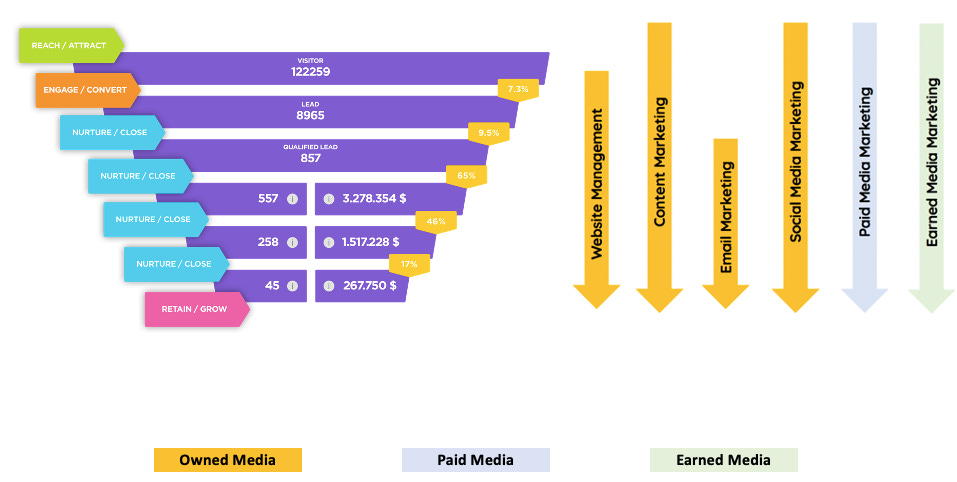
First, you should plan and execute a persona-based and data-driven content marketing strategy. Second, you should make sure that all your content marketing efforts are up and running at all growth marketing phases: reach/attract, engage/convert, nurture/close, and retain/grow. At each phase, the starting point should be the pain points of your target audience and how you can solve those problems. And each and every process should contain planning, creation, distribution, analysis, and optimisation.
1. Content Marketing Planning
Launch your content marketing strategy by setting goals and customising topics to target your personas. There are three major ways content media marketing drives success that align with the growth marketing phases:
Reach & Attract: Build brand awareness and attract your target persona.
Engage & Convert: Drive audience engagement and increase leads and conversions.
Nurture & Close: Convert your leads into customers.
Retain & Grow: Make your customers champions for your brand and secure their loyalty.
Then, you can tailor topics in order to target your personas by considering these key points:
Keyword: You can use Buzzsumo to get content insights into what kind of content performs the best within your industry. With the Google Keyword Planner, you can access historical statistics on search volumes by date range that will help you decide which keywords to use while creating your content.

Competitor analysis: In order to track your competitors’ organic positions for relevant keywords, you can use SEMrush. You can also set up a Position Tracking campaign and find out who your top competitors are for targeted keywords.
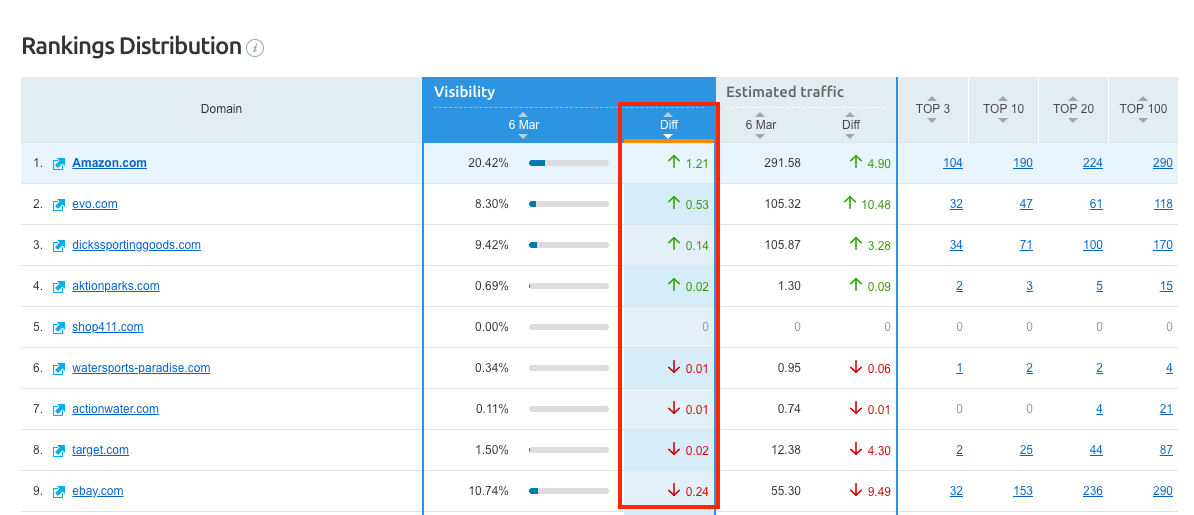
Source: SEMrush
Industry news and trends: Using Google Trends, you can identify industry trends and discover popular search terms or topics on Google. Social media management tools such as Hootsuite follow key conversations on social media channels and keep an eye on what people are talking about. You will figure out popular topics based on hashtags, location, or keywords.
Forums: Quora and Reddit, internet forum sites with user-generated content, show where people go to ask questions and get answers, which will help you come up with great content ideas.
FAQs and customer surveys: A review of frequently asked questions to Sales and Support Teams will help you decipher your customers’ pain points. Customer surveys will give you insight into why they are using your product or service.
All this research will give you the answer to what you should write about. But, you should also keep in mind that you create a piece of content for a certain audience. So, you need to have a clear idea of who your target persona is in order to create related content for that audience.
Bonus: A Useful Tool and a Guide for an Effective Content Marketing Planning
In order for you to plan and track your content marketing tactics and activities easily, take a look at our Content Marketing Planning Guide and learn how to create a content marketing plan, content types according to your personas and some tactics for you to use in your content marketing activities. Moreover, here’s our tool for Content Marketing Planning for you to practice and exercise on how to create new plans and track them.
2. Content Creation
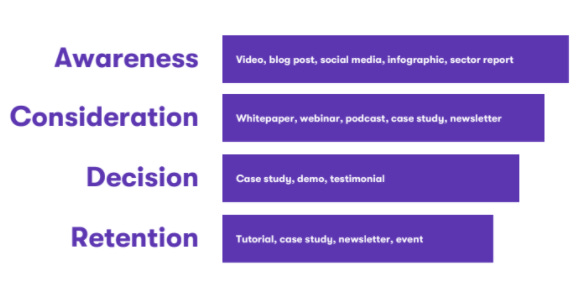
The customer journey is extremely complicated. Therefore, the effectiveness of content marketing depends on getting the right message to the right audience at the right time. You should create and curate content to communicate with consumers at key stages in the decision-making process. Here are the stages of the Buyer’s Journey and how to align your content marketing goals effectively with the Buyer’s Journey:
1. Awareness – Reach & Attract
This is the part where the buyer is aware that they have a problem or need, searches for answers, and gathers information. Here’s what you should do:
Provide a benefit
Focus on your personas’ problems and needs, not your product or service
Create content that will be useful and raise awareness
Take a position on critical keywords
Create content focusing on keywords “how to, when is, what is, where can I”
Avoid using technical jargon
Map related content to the Awareness stage
Create instructional and inspiring content such as blog posts, whitepapers, e-books, industry analysis reports, expert opinions, and long-form educational videos
2. Consideration – Engage & Convert
Consideration is the part where the buyer knows potential solutions to the problem and considers an initial set of companies. So, you should:
Produce consistent and personalised content
Craft consistent content for those who have previously contacted your brand at each stage of their journey
Take advantage of marketing automation tools to personalise content
Generate specific content
Target long-tail keywords with low search volumes but high conversion rates
Map related content to the Consideration stage
Create helpful content that describes the possible solutions, such as comparison videos, ebooks, infographics, podcasts, and case studies
3. Decision – Nurture & Close
The buyer is ready to make a decision and compares alternative solutions. Focus on;
Convincing and inspiring content
Retarget the people who’ve been through the phases of awareness and consideration phases to speed up their decision-making process
Offer financial incentives
Provide user-generated content
Highlight the content from previous and existing customers that will reduce the anxiety of your potential customers who wish to make the right purchasing decision
Incentivise potential customers with reliable and convincing content produced by your consumers
Map related content to the Decision stage
Create persuasive content such as demos, free trial accounts, webinars, case studies, and testimonials
4. Retention – Retain & Grow
The buyer has already made a decision but needs to be reminded of why they first engaged with you. You should:
Focus on customer retention and loyalty
Generate content to increase the satisfaction of existing customers and turn them into loyal customers
Encourage repeat purchases
Map related content to the Retention stage
Show your customers how to use your product or service better with tutorial videos and case studies
Most popular content formats
There are a variety of content marketing formats. You need to decide what type of content your potential buyers want to consume. You can consider using:
Blog posts
Ebooks
Infographics
White papers and reports
Videos
Case studies
3. Content Publishing
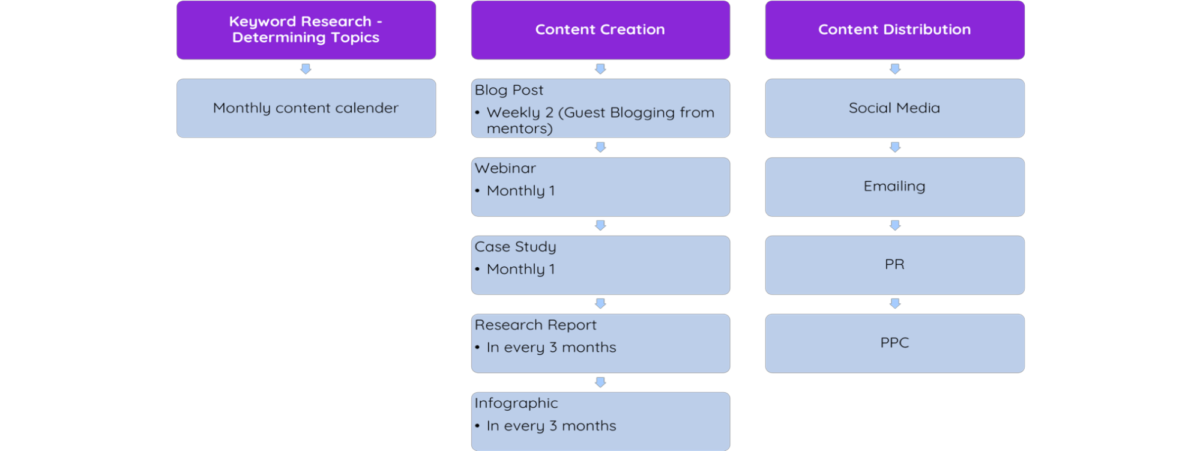
Create a content calendar. Determine which owned, earned, and paid channels you’ll be using to deliver content to your target audience.
Owned Media Channels: Share your content on your brand’s website and social media channels. Weaving some of the best SEO practices into your content will help make a good impression on Google and move your website up the ranking list. And through social media posts*, you can gain website traffic or grab the attention of your target audience.
While publishing content on your own website, consider these key points in order to rank high in search engines:
Form a hierarchical structure where users find content easily
Include keywords in content title, subtitle, and captions
Focus on long-tail keyword**
Create content containing a minimum of 500 words***
Publish content regularly
Use link building and internal linking
Publish each content on your own website to avoid a duplicate content problem
*LinkedIn is the most effective social media platform for delivering content and securing audience engagement (Source: https://www.hubspot.com/marketing-statistics)
** 50% of search queries are four words or longer
*** Long-form content of over 1,000 words consistently receives more shares and links than shorter form content
Paid Media Channels: Boost your conversion rates and shorten your sales cycle with paid advertising, such as sponsored content, pay-per-click (PPC), search engine marketing (SEM), display, and retargeting. You can decide which paid media channel to invest in by looking at where your brand’s personas are.
Earned Media Channels: This is one of the most valuable yet hardest to secure promotion channels. You can directly contact PR networks or get in touch with publishing networks to specifically create the kind of content they’re looking for.
4. Content Marketing Analysis
Determine key performance indicators (KPIs) for your content marketing goals. KPIs are quantifiable data points for measuring your actual content performance against your content marketing objectives. For each growth phase, you can set up and track these KPIs:
Awareness – Reach & Attract: Site traffic, organic traffic, visitors from social media posts, average time on content pages, bounce rates
Consideration – Engage & Convert: Conversion rate from organic visitors, ROAS, total engagement, newsletter sign-ups, remarketing audience, backlinks, brand mentions on 3rd party websites
Decision – Nurture & Close: Conversion quality (lead quality) from organic visitors, content-based lead quality, conversion value from organic visitors, conversion value from referral websites, ROI, conversion value from specific landing pages
Retention – Retain & Grow: Net promoter score, customer lifetime value, customer retention rate
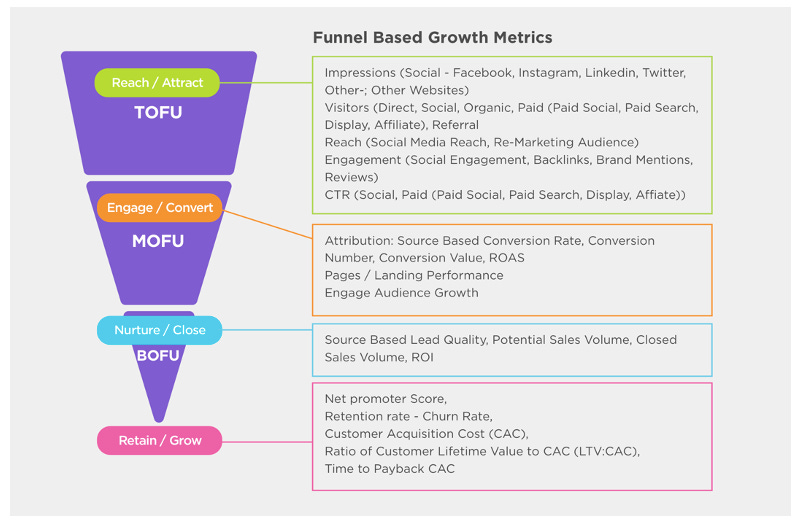
To measure the success of your content marketing strategy, you can use:
Google Analytics: This allows you to understand which keywords increase traffic to your content and which types of content are most effective at keeping visitors on your website, as well as which content is leaking. Such analysis can help you optimise your content marketing strategy from planning to execution.
SEMrush: With keyword position tracking, you can track your website’s ranking for target keywords in the Google top 100 organic results and compare your performance to your competitors’ by monitoring their improved/declined keywords.
CRM: CRM tools like HubSpot allow you to monitor your website performance and analyse which content is driving the most conversions. All you have to do is connect your website and HubSpot account. Once your leads are synced from the landing pages into the HubSpot CRM system, you will begin to measure the effectiveness of every gated content, such as whitepapers, case studies, and such.
5. Content Marketing Optimisation
Optimisation is a persistent effort to improve content performance. It starts with measuring content at each stage with related metrics. Data will show you what’s working and what’s not. Thus, you should optimise your content marketing strategy and make your content as effective as possible.
Optimise for customers: Regardless of content quality, if customers can’t read it, or it’s too hard to understand, they will bounce.
Optimise for search engines: Make every page of your content an entry point to your business. Produce mobile-first content, write a meta-description with keywords in it, and speed up loading times.
Optimise for social media: Make it easy for your website visitors to share your content. Add buttons that your audience uses for social media platforms. Post content on related social media platforms.
Optimise for your business: Ensure that your visitors take action to engage with your brand. Include relevant calls-to-action (CTAs), add links to relevant website pages to convert your visitors into leads.